
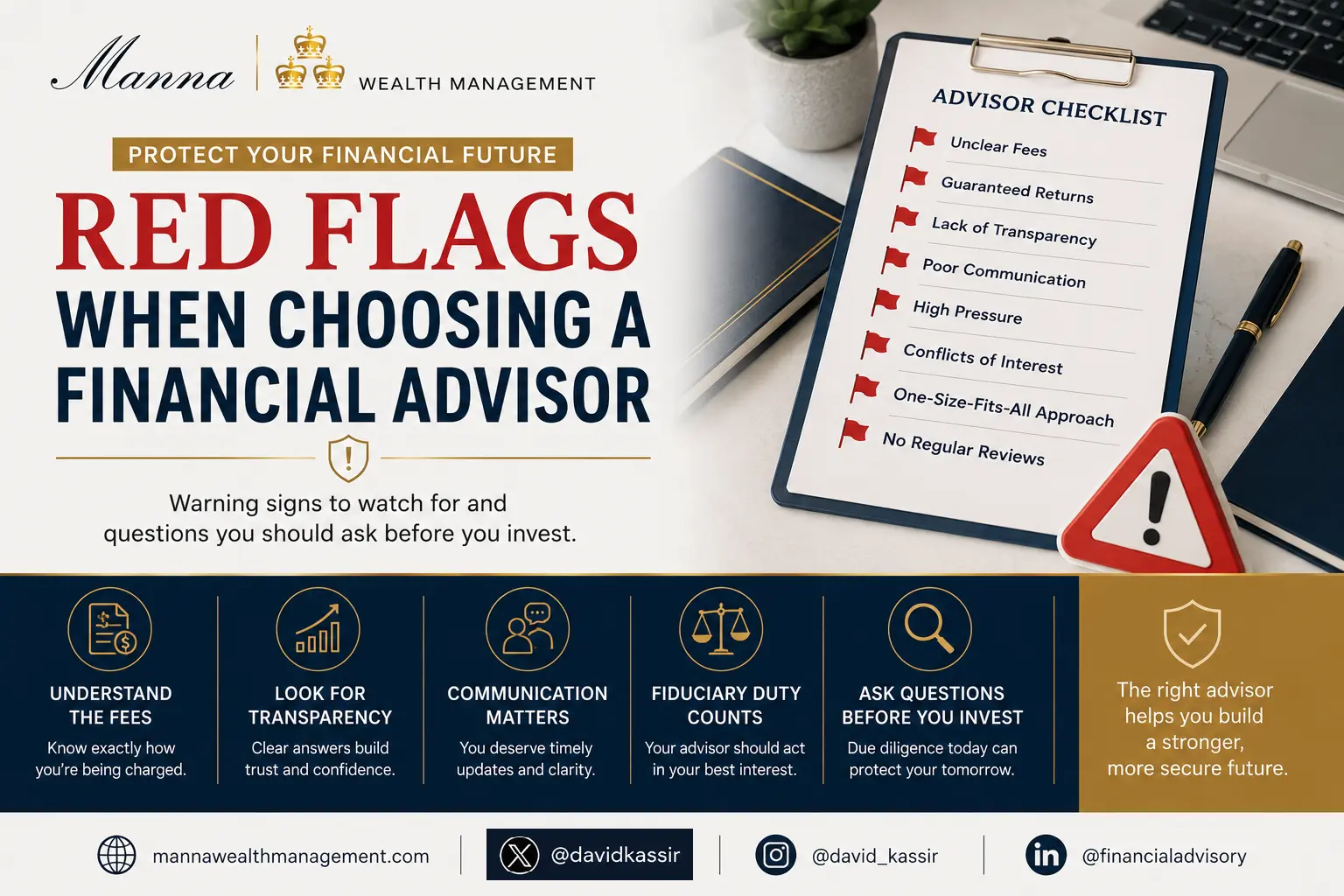
Selecting a financial advisor is an important decision that may influence many aspects of your financial life, including retirement planning, investment management, tax-aware financial planning, estate planning coordination, and long-term wealth preservation.
Most financial advisors strive to provide professional guidance and maintain long-term client relationships. However, investors should still take time to evaluate any advisory relationship carefully. Asking thoughtful questions, reviewing regulatory disclosures, understanding compensation, and evaluating communication practices can help you make a more informed decision.
For individuals, retirees, executives, business owners, and families in Malibu and throughout Southern California, choosing an advisor often involves more than comparing investment strategies. The planning process, fiduciary responsibilities, transparency, and ongoing communication may all play an important role.
A concern that appears to be a “red flag” does not necessarily indicate misconduct or regulatory violations. In many cases, it simply suggests that additional questions may be appropriate before moving forward. This article highlights common warning signs investors may wish to evaluate while recognizing that every advisory relationship is unique.
This article is provided for educational purposes only and should not be considered individualized investment, legal, or tax advice.
Why Due Diligence Matters
Choosing a financial advisor involves more than reviewing a website or comparing investment performance.
Investors may benefit from evaluating:
- Professional qualifications
- Advisory services
- Fiduciary responsibilities
- Compensation structure
- Regulatory disclosures
- Communication style
- Planning process
- Experience with similar financial situations
Conducting due diligence may help you better understand how an advisor works and whether their services align with your financial goals. However, no evaluation process can guarantee that a particular advisory relationship will meet every expectation or produce specific financial outcomes.
Understand the Advisor’s Role
Before evaluating warning signs, it is helpful to understand what services the advisor actually provides.
Some financial professionals focus primarily on:
- Investment management
- Retirement planning
- Financial planning
- Executive compensation
- Estate planning coordination
- Business succession planning
- Cash flow planning
Service offerings vary significantly between firms.
Rather than assuming every financial advisor offers the same services, ask for a detailed explanation of the advisory relationship, including what is included, what requires additional fees, and when outside professionals may become involved.
Understanding these details may reduce misunderstandings later. However, the breadth of services alone does not determine the quality or appropriateness of financial advice.
Red Flag #1: Unclear Fee Structure
One of the first topics to discuss is compensation.
If it is difficult to understand how an advisor is paid, additional questions may be appropriate.
Consider asking:
- How are advisory fees calculated?
- Which services are included?
- Are there additional planning fees?
- Will other professionals charge separate fees?
- Are fees asset-based, hourly, fixed, or another structure?
Transparent fee discussions may help investors compare advisory firms more effectively.
However, lower fees do not necessarily indicate better value, and higher fees do not automatically reflect more comprehensive planning. The overall advisory relationship should be evaluated together with the services provided.
Red Flag #2: Promises of Guaranteed Results
Financial markets involve uncertainty.
Be cautious if an advisor appears to guarantee:
- High investment returns
- Market outperformance
- Consistent profits
- Risk-free investing
- Certain retirement outcomes
- Guaranteed wealth preservation
Investment recommendations always involve risk, including the possible loss of principal.
Discussing historical investment approaches or planning assumptions is different from guaranteeing future results. Investors should ask how recommendations are developed and what risks could affect expected outcomes.
Red Flag #3: Limited Transparency
Transparency is an important part of an advisory relationship.
You should feel comfortable asking about:
- Advisory agreements
- Form ADV
- Fee schedules
- Conflicts of interest
- Investment philosophy
- Planning process
- Client communication
If explanations are unclear or important documents are difficult to obtain, consider requesting additional information before making a decision.
A lack of immediate documentation does not necessarily indicate misconduct, but investors should understand the advisory relationship before entering into an agreement.
Red Flag #4: Poor Communication
Communication expectations should be discussed early.
Questions to ask include:
- How often are review meetings scheduled?
- Who will be my primary contact?
- How quickly are client questions answered?
- How are financial updates communicated?
- What happens during periods of market volatility?
Good communication may help clients stay informed about their financial plans.
However, frequent communication alone does not indicate higher-quality financial advice, nor does less frequent communication necessarily reflect poor service. The appropriate communication schedule depends on the services provided and the client’s preferences.
Red Flag #5: Pressure to Make Immediate Decisions
Financial decisions often deserve careful consideration.
If you feel pressured to:
- Sign documents immediately
- Transfer assets without adequate explanation
- Purchase products before understanding them
- Skip reviewing disclosure documents
consider requesting additional time to evaluate the information.
Some financial opportunities may involve deadlines, but investors should generally have sufficient time to understand advisory agreements, compensation, risks, and planning recommendations before making important financial decisions.
Pressure alone does not establish inappropriate conduct, but it may justify asking additional questions or seeking clarification.
Red Flag #6: Unclear Fiduciary Responsibilities
Many investors ask whether their financial advisor acts as a fiduciary. While this is an important question, the answer may depend on the services being provided and the applicable regulatory framework.
Consider asking:
- Are you acting as a fiduciary for the advisory services you provide?
- Does fiduciary responsibility apply throughout our entire relationship?
- How are potential conflicts of interest identified and disclosed?
- How do you determine whether recommendations are appropriate for my financial circumstances?
- Can you explain how your advisory obligations apply to my account?
Understanding fiduciary responsibilities may help you better evaluate the advisory relationship. However, fiduciary status alone does not determine the quality of financial advice, the scope of services, or future investment outcomes. Investment recommendations continue to involve risk, and even fiduciary advisors cannot guarantee financial results.
Red Flag #7: A One-Size-Fits-All Planning Approach
Every investor has unique financial goals, family circumstances, income needs, and risk tolerance.
If an advisor recommends the same planning approach for every client without first learning about your situation, consider asking additional questions about how recommendations are developed.
A comprehensive planning discussion may include topics such as:
- Retirement objectives
- Investment experience
- Tax considerations
- Estate planning goals
- Cash flow needs
- Business ownership
- Charitable giving
- Family circumstances
A personalized planning process may help ensure recommendations reflect your financial situation. However, customized planning often requires additional time, documentation, and ongoing reviews, and even individualized recommendations cannot guarantee the achievement of financial goals.
Red Flag #8: Limited Review Meetings
Financial plans often require periodic updates as personal circumstances, tax laws, economic conditions, and financial goals change.
Ask questions such as:
- How often will my financial plan be reviewed?
- What events trigger additional meetings?
- How are major life changes incorporated into planning?
- How are investment strategies reviewed over time?
Regular reviews may help identify planning topics that deserve further discussion. However, more frequent meetings do not necessarily improve investment performance or financial outcomes. The appropriate review schedule depends on your advisory agreement and individual planning needs.
Red Flag #9: Recommendations Without Understanding Your Goals
A financial advisor should generally understand your financial circumstances before making recommendations.
Topics often discussed include:
- Financial objectives
- Time horizon
- Liquidity needs
- Income requirements
- Existing investments
- Family responsibilities
- Risk tolerance
If recommendations appear to be made before gathering sufficient information, consider asking how the advisor evaluates your overall financial situation.
Collecting detailed financial information may support more informed planning discussions. However, recommendations remain dependent on the accuracy of information provided, future assumptions, and changing market conditions.
Red Flag #10: Difficulty Explaining Investment Risks
Every investment involves risk.
If investment discussions focus primarily on potential rewards while providing little explanation of possible risks, costs, limitations, or uncertainties, additional questions may be appropriate.
Consider asking:
- What are the primary risks?
- What assumptions support this recommendation?
- Under what circumstances could this strategy perform differently than expected?
- What costs should I understand?
- What alternatives should I consider?
Balanced discussions that explain both potential benefits and material risks may help investors make more informed decisions. However, understanding risks does not eliminate them, and future market conditions remain unpredictable.
Questions to Ask Before Hiring a Financial Advisor
Preparing questions before your initial meeting may help you compare advisory firms more consistently.
Consider asking:
- What services are included in your advisory relationship?
- Are you acting as a fiduciary for these services?
- How are advisory fees calculated?
- How often will we meet?
- How is my financial plan developed and reviewed?
- How are conflicts of interest disclosed?
- How do you coordinate with my CPA or estate planning attorney when appropriate?
- What regulatory disclosures should I review?
- How are investment recommendations documented?
- What assumptions are used when developing financial projections?
These questions may provide additional insight into how an advisory relationship operates. However, the responses should be considered together with advisory agreements, disclosure documents, and your own financial goals before making a decision.
Considerations for Malibu Residents
Many individuals and families in Malibu have financial planning needs that extend beyond portfolio management.
Depending on your circumstances, planning discussions may include:
- Retirement income planning
- Executive compensation
- Business ownership
- Real estate holdings
- Estate planning coordination
- Trust administration
- Charitable giving
- Multi-generational wealth planning
Some advisory firms coordinate with attorneys, certified public accountants (CPAs), insurance professionals, and other specialists when appropriate and authorized by the client.
Such coordination may improve communication among professionals involved in your financial plan. However, each professional remains independently responsible for their own advice, additional professional fees may apply, recommendations may differ among advisors, and coordinated planning does not guarantee improved financial, legal, or tax outcomes.
Key Takeaways
When evaluating a financial advisor, remember these important considerations:
- Understand the services included in the advisory relationship.
- Ask how advisory fees are calculated.
- Confirm whether the advisor acts as a fiduciary for the services provided.
- Review regulatory disclosures and advisory agreements.
- Ask how conflicts of interest are identified and managed.
- Look for a planning process that considers your individual circumstances.
- Discuss communication expectations and review schedules.
- Understand both the potential benefits and the material risks of recommended strategies.
- Never hesitate to ask questions before making financial decisions.
No single warning sign automatically indicates that an advisor is unsuitable. Instead, use these considerations as part of a thoughtful evaluation process that reflects your own financial objectives and planning needs.
Frequently Asked Questions
What is the biggest red flag when choosing a financial advisor?
There is no single warning sign that applies in every situation. However, investors often pay close attention to unclear fee structures, limited transparency, pressure to make immediate decisions, vague explanations of investment risks, or difficulty obtaining regulatory disclosures. Any concern should prompt additional questions before entering into an advisory relationship.
Should every financial advisor act as a fiduciary?
Whether a financial professional acts as a fiduciary depends on the services provided and the applicable regulatory framework. Investors should ask how fiduciary responsibilities apply to their specific advisory relationship rather than assuming the same standard applies in every circumstance.
Is a higher advisory fee always a warning sign?
Not necessarily. Higher fees may reflect broader planning services, while lower fees may involve a more limited scope of services. Investors should evaluate both the fee structure and the services provided rather than relying on cost alone.
Why are disclosure documents important?
Disclosure documents, including Form ADV for registered investment advisers, provide information about services, fees, conflicts of interest, disciplinary history (if applicable), and business practices. Reviewing these documents may help investors better understand an advisory relationship, although they should be considered alongside direct discussions with the advisor.
Should I change advisors after one concern?
Not necessarily. A single concern may simply require additional clarification. Asking questions and reviewing documentation may resolve many issues. The decision to continue or change an advisory relationship should be based on your overall evaluation rather than one isolated factor.
Can a financial advisor guarantee investment returns?
No. Investment recommendations involve risk, including the possible loss of principal. Future market performance cannot be predicted with certainty, and financial professionals should avoid guaranteeing specific investment outcomes.
How often should my financial advisor review my plan?
The appropriate review schedule depends on your financial circumstances, the services included in your advisory relationship, and significant life events. Some investors meet annually, while others may prefer more frequent reviews based on their planning needs.
How can I compare multiple financial advisors?
Using a consistent checklist may help. Compare each advisor’s services, fiduciary responsibilities, compensation structure, planning process, communication practices, regulatory disclosures, and experience. The most appropriate advisor depends on your financial goals, personal preferences, and the scope of services you need.
Conclusion
Choosing a financial advisor involves more than comparing investment strategies or professional titles. Taking time to understand an advisor’s services, fiduciary responsibilities, compensation structure, planning process, communication style, and regulatory disclosures can help you make a more informed decision.
Rather than viewing red flags as automatic reasons to reject an advisor, consider them opportunities to ask additional questions and gain a clearer understanding of the advisory relationship. Transparency, balanced discussions of risks and potential benefits, and clear communication may contribute to a more informed decision-making process. At the same time, investors should recognize that even well-qualified advisors cannot predict future market conditions, eliminate investment risk, or guarantee financial success.
For individuals, retirees, executives, business owners, and families in Malibu and throughout Southern California, selecting a financial advisor is an important long-term decision. Reviewing advisory agreements carefully, understanding how recommendations are developed, and periodically reassessing your financial plan as your circumstances evolve may help ensure that your advisory relationship continues to align with your goals.
This article is provided for educational purposes only and should not be considered individualized investment, legal, tax, or accounting advice. All investments involve risk, including the possible loss of principal. Financial planning strategies depend on individual circumstances and may change as market conditions, tax laws, regulations, and personal objectives evolve. Before making financial decisions, consult qualified financial, legal, tax, or other professional advisors as appropriate.
