
Choosing the right financial professional can be challenging, especially when you see credentials such as CFP®, CFA®, and CPA after someone’s name. Although these designations are well known, they represent different areas of education, experience, and professional focus.
Understanding these differences can help you ask better questions and determine which type of professional may be appropriate for your financial situation. For some individuals, working with one professional may be sufficient. Others, particularly high-net-worth families, business owners, executives, and retirees, may benefit from coordinating with multiple professionals who have different areas of expertise.
For residents of Malibu and throughout Southern California, financial planning often involves investment management, retirement planning, tax considerations, estate planning coordination, business succession, and wealth preservation. These needs may require collaboration among financial advisors, tax professionals, and legal advisors.
This article explains the primary differences between CFP®, CFA®, and CPA professionals, the services they commonly provide, and the situations in which each may play a role. It is intended for educational purposes only and should not be considered individualized investment, legal, or tax advice.
What Do CFP®, CFA®, and CPA Mean?
Each credential represents a different area of professional education and practice.
Generally speaking:
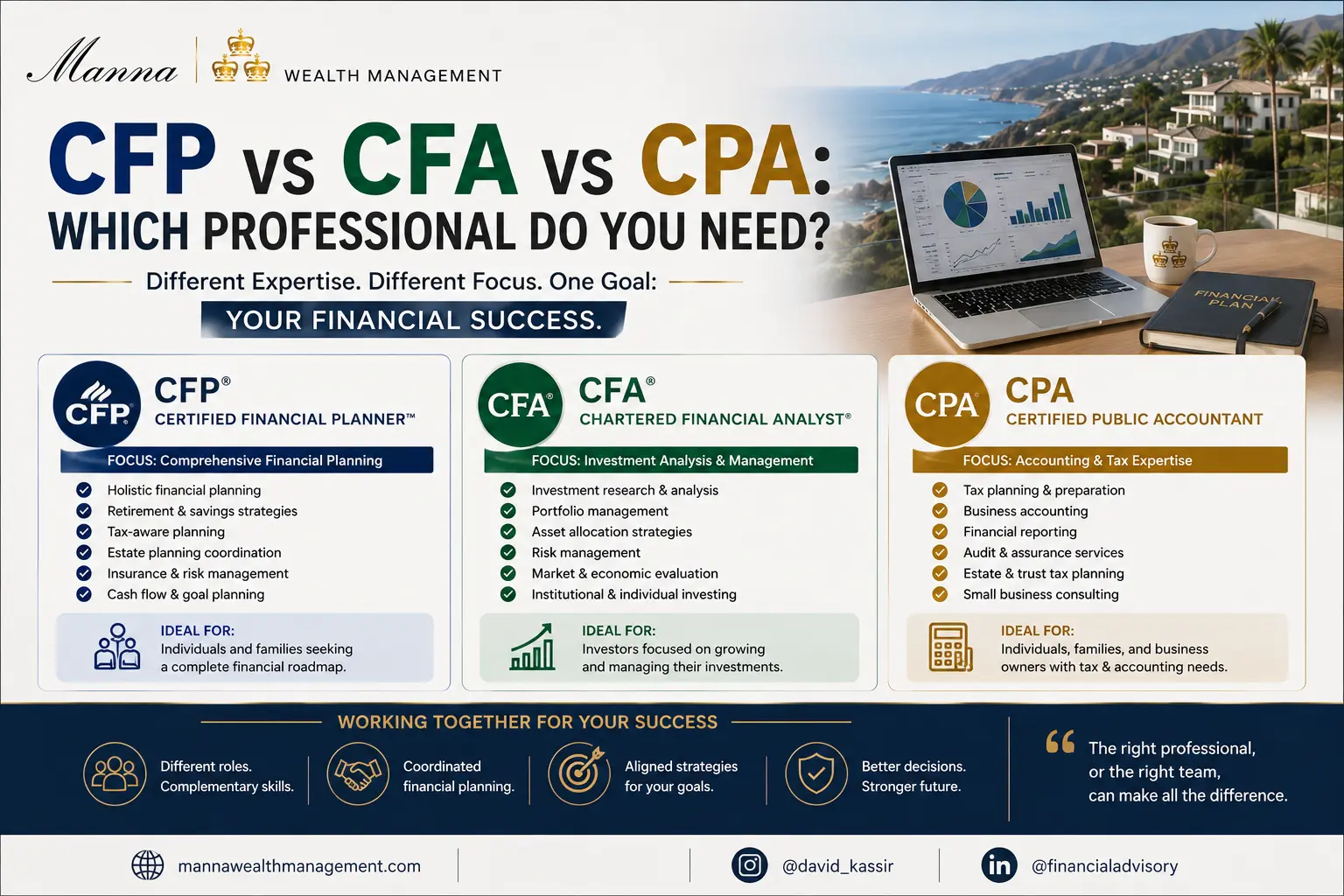
- CFP® (Certified Financial Planner®) professionals typically focus on comprehensive financial planning.
- CFA® (Chartered Financial Analyst®) charterholders generally specialize in investment analysis and portfolio management.
- CPA (Certified Public Accountant) professionals primarily focus on accounting, taxation, financial reporting, and related services.
Although these descriptions provide a helpful starting point, individual professionals may have different experience, areas of specialization, licenses, or service offerings. Investors should ask about the specific services a professional provides rather than relying solely on a credential.
Why Understanding Professional Credentials Matters
Many people assume every financial professional provides the same services.
In reality, responsibilities often differ depending on:
- Professional education
- Licensing
- Experience
- Regulatory requirements
- Scope of services
- Areas of specialization
Understanding these differences may help you identify the type of professional who best aligns with your financial questions. However, holding a credential alone does not guarantee the quality of advice, investment performance, tax outcomes, or financial results.
What Is a CFP® Professional?
A Certified Financial Planner® (CFP®) professional generally focuses on comprehensive financial planning.
Depending on the services offered, planning discussions may include:
- Retirement planning
- Investment planning
- Cash flow management
- Insurance planning
- Education funding
- Estate planning coordination
- Tax-aware financial planning
- Charitable giving
- Risk management
A CFP® professional often works with clients to organize multiple aspects of their financial life into a coordinated plan.
This comprehensive approach may help families better understand how different financial decisions relate to one another. However, comprehensive planning may involve ongoing advisory fees, periodic reviews, coordination with other professionals, and planning assumptions that can change over time. Financial plans do not guarantee specific outcomes and should be reviewed as circumstances evolve.
What Is a CFA® Charterholder?
A Chartered Financial Analyst® (CFA®) charterholder typically has extensive education related to investment analysis and portfolio management.
Areas of focus may include:
- Investment research
- Portfolio construction
- Risk analysis
- Asset allocation
- Equity analysis
- Fixed-income analysis
- Alternative investments
- Market evaluation
Many CFA charterholders work in investment management, institutional investing, research firms, wealth management firms, or portfolio management roles.
Strong investment knowledge may contribute to thoughtful portfolio analysis. However, investment strategies remain subject to market risk, changing economic conditions, and future uncertainty. Neither investment research nor portfolio management can eliminate the possibility of losses or guarantee investment performance.
What Is a CPA?
A Certified Public Accountant (CPA) primarily specializes in accounting and taxation.
Depending on their practice, CPAs may assist with:
- Tax preparation
- Tax planning
- Business accounting
- Financial reporting
- Audit services
- Estate and trust tax matters
- Small business consulting
Many individuals and business owners work with CPAs throughout the year rather than only during tax season.
Tax planning discussions may help identify opportunities to improve financial organization or prepare for future tax obligations. However, tax outcomes depend on current law, future legislative changes, accurate financial information, and individual circumstances. Tax advice should be based on your specific situation and may require updates as tax laws evolve.
Can One Professional Do Everything?
Not necessarily.
Many financial situations involve several areas of expertise.
For example:
- A CFP® professional may coordinate a comprehensive financial plan.
- A CFA® charterholder may contribute investment research or portfolio management expertise.
- A CPA may provide accounting and tax guidance.
Some professionals hold multiple credentials, while others work collaboratively with specialists in different fields.
Working with a team of professionals may improve communication across different areas of financial planning when authorized by the client. However, coordination can also increase overall professional costs, recommendations from different professionals may not always align, and each professional remains independently responsible for their own advice.
Which Professional May Be Appropriate for Different Financial Needs?
The answer depends on your objectives.
You may consider discussing your needs with a professional if you are seeking guidance related to:
- Retirement planning
- Investment management
- Tax planning
- Business ownership
- Estate planning coordination
- Wealth transfer
- Executive compensation
- Charitable giving
- Cash flow planning
Rather than focusing exclusively on a credential, ask whether the professional has experience providing the specific services you need.
Credentials can indicate education and professional commitment, but they do not replace thoughtful communication, a clear planning process, transparency regarding fees, or an understanding of your financial goals.
Questions to Ask Before Hiring a CFP®, CFA®, or CPA
Choosing the right financial professional involves more than verifying credentials. Asking thoughtful questions can help you better understand the professional’s services, communication style, compensation, and whether their expertise aligns with your financial needs.
Consider asking:
- Which professional credentials do you hold?
- What services do you personally provide?
- Which services require coordination with other professionals?
- Who are your typical clients?
- How are your fees calculated?
- How often will we meet?
- How do you communicate with clients throughout the year?
- How do you coordinate with attorneys, tax professionals, or other advisors when appropriate?
- What assumptions are used in financial projections?
- What regulatory disclosures should I review before becoming a client?
These discussions may help you compare professionals using consistent criteria. However, responses should be considered together with advisory agreements, disclosure documents, and your own financial objectives before making a decision.
Fiduciary Considerations
Many investors want to know whether the financial professional they hire acts as a fiduciary.
This is an important question, but the answer depends on the services being provided and the applicable legal and regulatory framework.
You may wish to ask:
- Are you acting as a fiduciary for the advisory services you provide?
- Does fiduciary responsibility apply throughout our relationship?
- How are conflicts of interest identified and disclosed?
- How do you determine whether recommendations are appropriate for my circumstances?
Understanding fiduciary responsibilities may provide greater clarity about the advisory relationship. However, fiduciary status alone should not be viewed as the only factor when selecting a financial professional. Investors should also consider experience, communication, service offerings, transparency, and whether the professional’s expertise aligns with their financial needs.
Even when a professional acts as a fiduciary, investment recommendations involve uncertainty. Fiduciary responsibilities cannot eliminate market risk, guarantee financial success, or ensure that every recommendation will produce favorable results.
Common Misconceptions
“A CFP®, CFA®, and CPA provide the same services.”
Although these professionals often work with similar clients, their education, experience, and primary areas of practice generally differ.
Understanding those differences may help you identify the professional—or combination of professionals—that best fits your needs.
“One credential is better than the others.”
There is no universally superior credential.
Each designation reflects a different area of expertise.
The most appropriate professional depends on your financial questions, planning objectives, and the services you require.
“A credential guarantees better financial results.”
Professional credentials demonstrate education, examination requirements, and ongoing professional standards.
However, no credential guarantees investment performance, tax savings, financial success, or the achievement of long-term financial goals.
Financial outcomes depend on many factors, including market conditions, tax laws, personal circumstances, and future economic events.
“I only need one financial professional.”
Some individuals work with one advisor throughout their financial lives.
Others—particularly business owners, retirees, executives, and high-net-worth families—may benefit from working with several professionals whose expertise complements one another.
Collaboration among professionals may improve communication and planning efficiency when authorized by the client. However, multiple advisors may also increase professional costs, recommendations may differ, and coordination does not guarantee better financial outcomes.
Considerations for Malibu Residents
Many individuals and families in Malibu have financial situations that extend beyond investment management alone.
Planning discussions may involve:
- Retirement income planning
- Executive compensation
- Family businesses
- Real estate investments
- Trust administration
- Estate planning coordination
- Tax planning discussions
- Charitable giving
- Multi-generational wealth planning
Depending on your circumstances, you may work with a financial advisor, CPA, estate planning attorney, insurance professional, or investment specialist as part of a coordinated planning process.
Coordinated planning may improve communication among professionals when authorized by the client. However, each professional remains independently responsible for their own advice, additional professional fees may apply, and differing professional opinions may require further discussion before decisions are made.
Key Takeaways
Understanding professional credentials can help you make more informed financial decisions.
Keep these points in mind:
- CFP®, CFA®, and CPA professionals generally specialize in different areas.
- Choose a professional based on your financial needs rather than credentials alone.
- Ask detailed questions about services, compensation, communication, and fiduciary responsibilities.
- Review disclosure documents before entering into an advisory relationship.
- Consider whether your financial situation would benefit from coordination among multiple professionals.
- Understand both the potential benefits and the limitations of any planning strategy.
- Review your financial plan periodically as your goals and circumstances change.
There is no single credential that is appropriate for every investor. The right professional depends on your individual objectives, financial complexity, and the services you value most.
Frequently Asked Questions
What is the difference between a CFP®, CFA®, and CPA?
A CFP® professional generally focuses on comprehensive financial planning, a CFA® charterholder typically specializes in investment analysis and portfolio management, and a CPA primarily provides accounting and tax-related services. Individual experience and service offerings may vary.
Which credential is best for retirement planning?
Retirement planning often involves multiple financial considerations. Many investors work with professionals who provide comprehensive financial planning, while others also involve CPAs for tax matters or other specialists depending on their circumstances. The appropriate choice depends on your individual needs.
Should I hire both a financial advisor and a CPA?
Some investors choose to work with both professionals because their areas of expertise may complement one another. Coordination may improve communication regarding financial planning, but each professional remains responsible for their own advice, and additional professional fees may apply.
Does a CFA® charterholder manage investments?
Many CFA® charterholders work in investment management or portfolio analysis. However, job responsibilities vary by employer, licensing, and professional role. Investors should ask about the specific services offered rather than relying solely on the credential.
Does a CFP® professional provide tax or legal advice?
A CFP® professional may discuss tax-aware financial planning or coordinate with attorneys and CPAs, but they generally do not provide legal or tax advice unless separately qualified or licensed to do so.
Can one professional hold multiple credentials?
Yes. Some professionals earn more than one designation, such as a CFP® and CPA or a CFP® and CFA®. Multiple credentials may reflect broader education and experience, but they do not guarantee the quality of advice or financial outcomes.
How can I verify a financial professional’s background?
Investors may review regulatory disclosures, professional credentials, licensing information, and publicly available registration records where applicable. Reviewing these resources may provide useful information, but they should be considered alongside direct conversations and written advisory agreements.
How should I choose the right financial professional?
Begin by identifying your financial goals and the services you need. Compare professionals based on experience, credentials, communication style, compensation, fiduciary responsibilities where applicable, and the scope of services offered. The most appropriate choice depends on your unique financial circumstances rather than any single designation.
Conclusion
Understanding the differences between CFP® professionals, CFA® charterholders, and CPAs can help you ask more informed questions and build the right team of professionals for your financial needs. Each credential represents a different area of education and expertise, and no single designation is designed to address every aspect of financial planning.
For many individuals, retirees, executives, business owners, and high-net-worth families in Malibu and throughout Southern California, financial planning may involve investment management, retirement planning, tax considerations, estate planning coordination, and long-term wealth preservation. Depending on your circumstances, working with one professional or a coordinated team may be appropriate.
When evaluating financial professionals, focus on understanding their services, qualifications, communication practices, compensation, regulatory disclosures, and how they approach your specific planning needs. A thoughtful evaluation process may help you make a more informed decision, but no credential, planning strategy, or advisory relationship can eliminate investment risk, predict future market conditions, guarantee tax savings, or ensure the achievement of financial goals.
This article is provided for educational purposes only and should not be considered individualized investment, legal, tax, or accounting advice. All investments involve risk, including the possible loss of principal. Financial planning strategies depend on individual circumstances and may change as tax laws, regulations, market conditions, and personal objectives evolve. Consult qualified financial, tax, legal, or other professional advisors before making financial decisions.
