
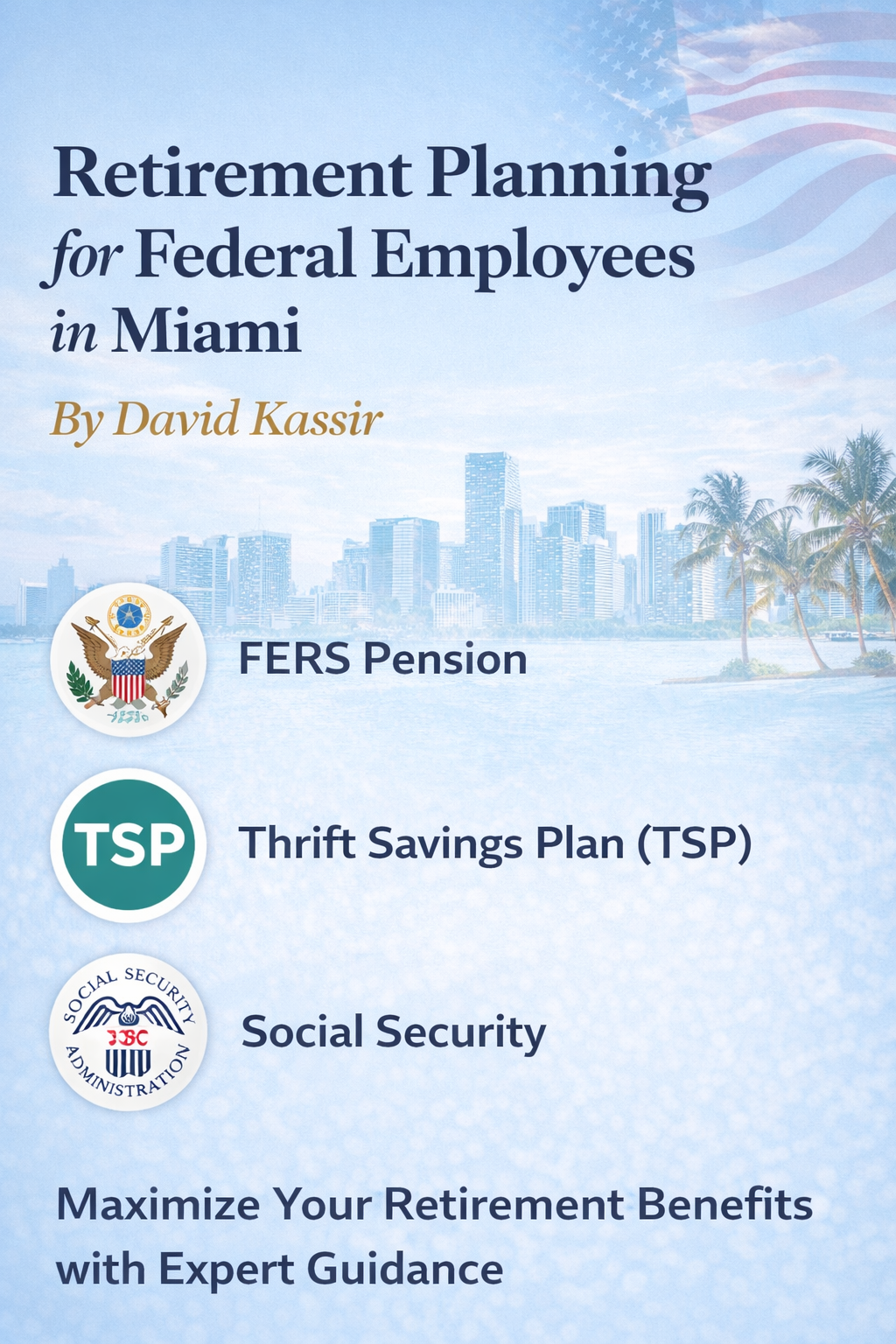
As a financial advisor working with professionals across South Florida, I often speak with federal employees who want clarity around their retirement options. Federal benefits can be powerful—but they are also complex. Coordinating pensions, Thrift Savings Plan (TSP) assets, Social Security, and personal investments requires careful planning.
This article is provided for educational purposes only and should not be considered personalized investment, tax, or legal advice. Each federal employee’s situation is unique and should be evaluated individually.
Understanding the Federal Retirement System
Most federal employees in Miami fall under the Federal Employees Retirement System (FERS), which includes three primary components:
- FERS Pension
- Thrift Savings Plan (TSP)
- Social Security Benefits
Each component plays a different role in retirement income planning.
The FERS Pension: A Foundational Income Source
Your FERS pension is based on:
- Years of creditable service
- High-3 average salary
- Retirement age
The timing of retirement significantly impacts pension income. Early retirement may reduce benefits, while delayed retirement can increase lifetime payouts.
Understanding your eligibility—such as Minimum Retirement Age (MRA) and years of service—is critical when building a retirement timeline.
Maximizing the Thrift Savings Plan (TSP)
The TSP is a defined contribution plan similar to a 401(k). Federal employees may contribute pre-tax (Traditional) or after-tax (Roth) dollars, subject to annual IRS limits.
Key considerations include:
- Contribution strategy
- Agency matching
- Allocation among G, F, C, S, and I Funds
- Withdrawal planning in retirement
All investments involve risk, including possible loss of principal. Past performance does not guarantee future results.
Asset allocation and diversification strategies do not ensure profit or protect against loss in declining markets.
Social Security Coordination
Because FERS employees participate in Social Security, claiming strategy matters. Factors to consider include:
- Full retirement age
- Delayed retirement credits
- Spousal benefits
- Taxation of benefits
Coordinating Social Security with pension and TSP withdrawals may improve long-term income efficiency.
Healthcare and FEHB in Retirement
One of the most valuable benefits for federal employees is continued access to the Federal Employees Health Benefits (FEHB) program in retirement, provided eligibility requirements are met.
Healthcare planning should address:
- Medicare enrollment timing
- FEHB coordination with Medicare
- Long-term care considerations
Medical costs can materially impact retirement cash flow projections.
Tax Planning for Federal Retirees in Miami
Florida’s absence of state income tax can be beneficial for retirees. However, federal taxation still applies to:
- Pension income
- TSP withdrawals
- Social Security (depending on income levels)
- Capital gains
Strategic withdrawal sequencing—such as balancing taxable, tax-deferred, and Roth accounts—may help manage overall tax exposure.
Tax outcomes vary based on individual circumstances and current law.
The Importance of a Withdrawal Strategy
Retirement planning is not only about accumulation. It is equally about distribution.
Federal employees should consider:
- Required Minimum Distributions (RMDs)
- Longevity risk
- Inflation risk
- Portfolio sustainability
- Income stability
A structured income strategy can help align retirement spending with long-term financial goals.
Estate and Beneficiary Planning
Federal benefits require proper beneficiary designations. This includes:
- TSP beneficiaries
- Pension survivor elections
- Life insurance beneficiaries
Failure to coordinate beneficiary designations with estate planning documents can lead to unintended outcomes.
Transition Planning: 5–10 Years Before Retirement
The final years before retirement are often the most critical.
Important steps may include:
- Pension estimate review
- TSP contribution adjustments
- Debt reduction planning
- Income gap analysis
- Risk tolerance reassessment
Making informed decisions before retirement begins can create greater flexibility afterward.
Final Thoughts
Retirement planning for federal employees in Miami involves more than selecting investments. It requires thoughtful coordination of pension income, TSP strategy, Social Security timing, tax efficiency, and healthcare planning.
With proper planning, federal employees may:
- Improve income predictability
- Reduce unnecessary tax exposure
- Preserve purchasing power
- Transition into retirement with clarity
Advisory services are offered only pursuant to a written agreement. This material is for informational and educational purposes only and does not constitute a recommendation or solicitation to buy or sell any security. Investment advisory services involve risk, including the potential loss of principal.
Frequently Asked Questions
1. When can I retire under FERS?
Retirement eligibility under FERS depends on your age and years of creditable service. Many employees qualify at their Minimum Retirement Age (MRA) with at least 30 years of service, age 60 with 20 years, or age 62 with 5 years. Early retirement options may be available in certain circumstances, but benefits may be reduced.
2. Should I choose a survivor benefit for my pension?
Electing a survivor benefit reduces your monthly pension but provides continued income for a spouse after your death. The appropriate decision depends on household income needs, life expectancy, and other available assets. This election is typically irrevocable after retirement.
3. How much should I contribute to my Thrift Savings Plan (TSP)?
At minimum, many employees aim to contribute enough to receive the full agency match. Beyond that, contribution levels should reflect retirement goals, cash flow, and tax strategy. Contribution limits are set annually by the IRS and may change over time.
All investments involve risk, including possible loss of principal.
4. Should I choose Traditional or Roth TSP contributions?
Traditional contributions reduce taxable income today but are taxed upon withdrawal. Roth contributions are made with after-tax dollars but may allow tax-free qualified withdrawals in retirement. The right choice depends on current income, projected retirement income, and tax considerations.
5. When should I claim Social Security?
Claiming early reduces monthly benefits, while delaying past full retirement age may increase lifetime payments. The optimal claiming strategy depends on life expectancy, marital status, and overall retirement income planning.
6. How are FERS pensions and TSP withdrawals taxed?
FERS pension income is generally subject to federal income tax. TSP withdrawals are taxed depending on whether contributions were Traditional or Roth. Social Security benefits may also be partially taxable depending on total income levels.
Tax outcomes vary based on individual circumstances and current law.
7. Do I need Medicare if I have FEHB?
Many federal retirees enroll in Medicare Part A at age 65. The decision to enroll in Part B depends on healthcare needs, premium costs, and coordination with FEHB coverage. Healthcare planning should be reviewed before turning 65.
8. How often should I review my retirement plan?
At least annually, and more frequently during the final years leading up to retirement. Changes in income, health, federal regulations, or personal goals may warrant adjustments.
